How The Forge inventory optimizer works
Treat the grid on the left as your in-game inventory. There is no button to press: The Forge optimizer shows the best crafts on the right as you type, and your numbers stay saved on this device for next time.
Find your ores
Search by name, or tap the arrow to sort the grid by multiplier so your strongest ores sit at the top.
Type what you own
Enter the amount in each ore's box. Ores you own get a red frame and count toward the total under Your Inventory.
Read the cards
One card per weapon or armor type, strongest first: odds, the exact mix, multiplier, likely item and active traits.
Open it in the forge
Open in forge calculator loads that mix into the main calculator, where you can change quality and enhancement.
For every weapon type (or armor type in Tank mode) The Forge optimizer first picks the ore count. In Best odds mode that is the count, up to what you own, where the type has its highest chance in the forge you selected. It then tests every combination of up to four of your strongest ore types and keeps the mix with the highest average multiplier for that count. The results are sorted by Masterwork damage or health, so the strongest craft you can make right now is at the top.
Example: 12 Obsidian and 20 Iron
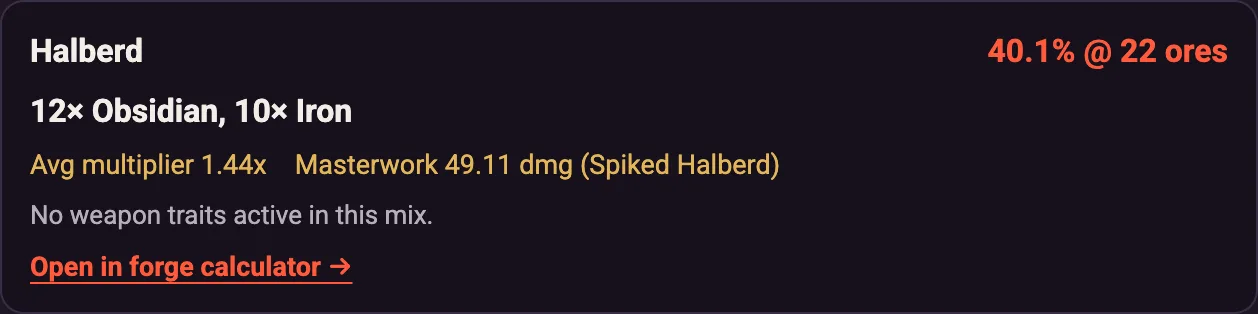
Say you have 12 Obsidian and 20 Iron. In Damage mode at the World 4 forge, The Forge optimizer puts a Halberd on top: 22 ores (all 12 Obsidian plus 10 Iron) give it a 40.1% chance, with an average multiplier of 1.44x and 49.11 Masterwork damage on a Spiked Halberd. A Great Axe from the same 22 ores is right behind at 45.39.
A 12-Obsidian Katana has the better multiplier, 2.35x, and a 58.7% chance, yet it lands lower in the list at 39.95 damage. Heavy types start from a higher base damage, so padding them with Iron still wins. If you would rather keep every ore pure, that Katana card is the one to open.
Tank, Damage and Lock 100%
Three rows of buttons above the results decide what The Forge optimizer plans for. Changing any of them re-ranks the cards straight away.
Damage or Tank
Damage plans weapons and ranks them by Masterwork damage. Tank plans armor and ranks it by health bonus.
Odds or molds
Best odds forges each type at the size where it rolls most often. Lock 100% uses the mold-lock count, the size at which molds can lock the exact item you want.
W1 to W4 and Guild
Each island forge offers different types and items, so the same inventory can rank differently in World 1 and World 4.
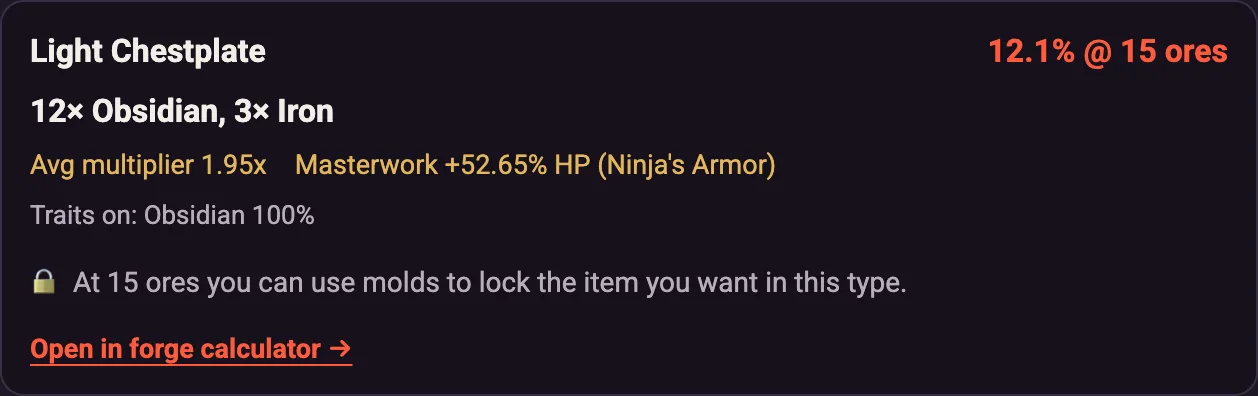
Switch The Forge optimizer to Tank and the mold-lock rule with the same 12 Obsidian and 20 Iron, and the top card becomes a Light Chestplate at 15 ores: 12 Obsidian and 3 Iron, a 1.95x multiplier and +52.65% health on Ninja's Armor. At 15 ores molds can lock the exact chestplate, even though the type itself only rolls 12.1% of the time.
Obsidian's trait, Vitality (+30% max health), is armor-only, so it switches on here at full power but never for weapons. That is why the same ores can look weak in Damage mode and strong in Tank mode.
Getting more from your ores
Traits need a share of the forge. An ore's trait only works when it makes up at least 10% of the ores, and reaches full power at 30%.
The multiplier is an average, so a few strong ores in a small forge often beat a big forge padded with weak ones. If a bigger type needs more ores than your best ores can fill, The Forge optimizer shows how far the average drops. Mining or crafting a handful more of your top ore is usually the cheapest upgrade; the The Forge recipes page shows what each crafted ore costs, and the The Forge pickaxes list shows which pickaxe can reach the rocks that drop it.